It is interesting to think about what brings us to a place.
Imanalla! Sa’ch’o! Hola! Hello!
Here’s something I hope you think about often: culture and language give us plans and general outlines for how we understand the act of building a home. In my language, the process of imagining and reproducing the building of a home is held in the word wasichina—to build a home.
I’ve been looking for an excuse to talk about one of my favorite words and, conveniently, to introduce myself.
Four years ago, I arrived in Kingston by Greyhound, bright blue tiny suitcase in tow, and took my first stroll around the city to meet K Greene, steward and Director of Seeds and Engagement for the Hudson Valley Farm Hub for the first time. And if, like me, you’ve been carrying seeds in your pockets since the tender age of three, there’s a good chance you’ve met K locally, in some capacity.
Our first exchange in person set the high standards for how I think about introductions now.
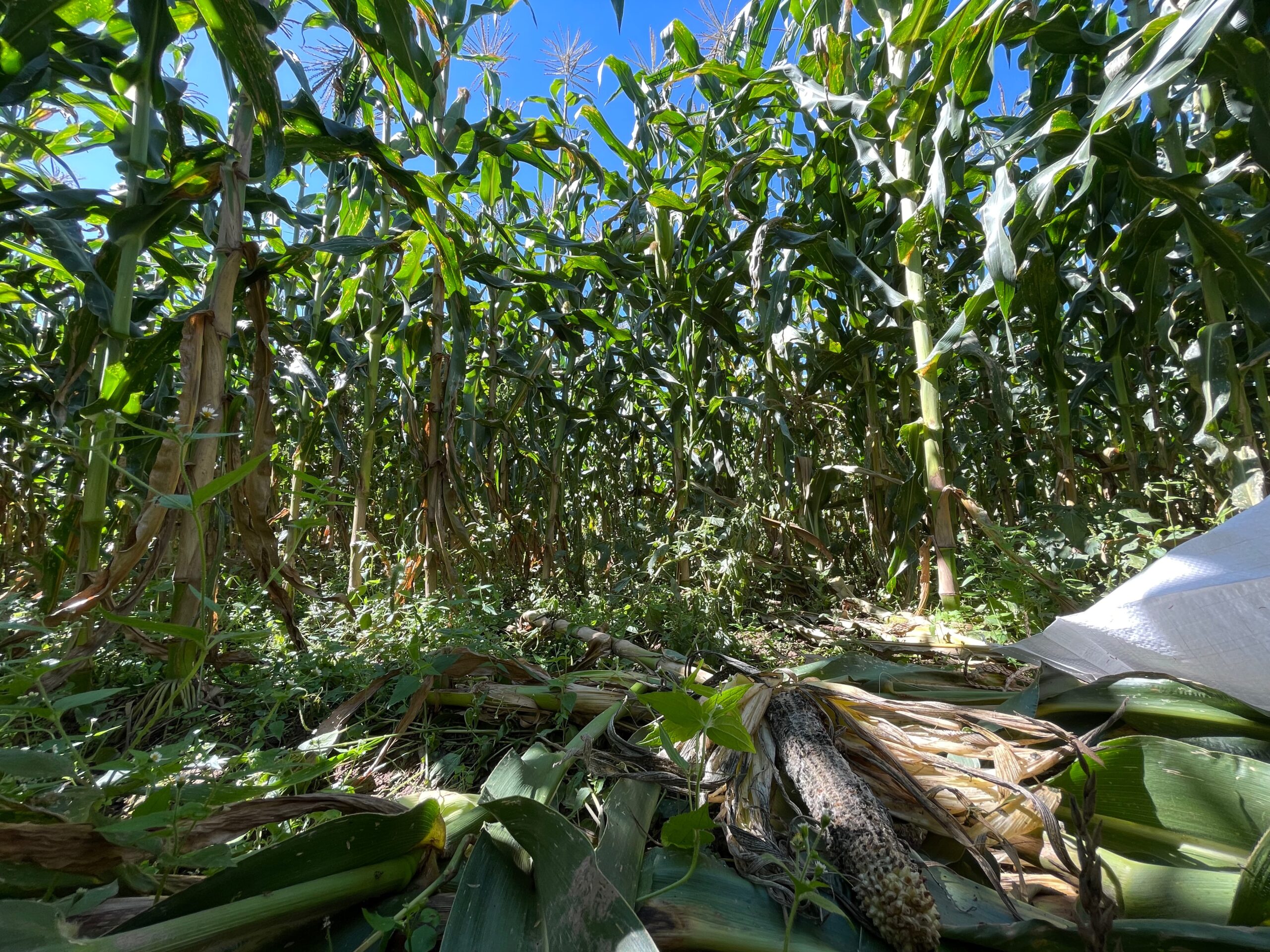
We exchanged the seeds we were carrying in our pockets. I had a Kiru Sara, a corn seed from my community; K gifted me a Cardiospermum halicacabum, otherwise known as balloon vine.
The rest is seedstory.
In one way or another, my prayers and my work have been part of this area longer than my physical presence has. I like to think of it as arriving somewhere late to a conversation that had already begun.
I moved to Kingston in 2025, partially for love and partially for seeds. I’m not sure if there’s much difference between the two.
Seeds are a map I use to navigate the world around me. I like to think of them as both my beginning and my end: tiny archives of where we’ve been, instructions for where we might go, and occasionally, a very good reason to decide where to build a home.
For almost a decade, my work has held agricultural seeds within Indigenous food kinship—these include non-agricultural seeds cataloged as red listed and returned to landscapes—for restoration and commercial networks. I’ve had the great privilege of collaborating with Tribal Nations across Turtle Island and Abya Yala—ancestral names for “The Americas.”
In 2022, I co-founded a consultancy called Inside The Husk with a Sandia Pueblo and Diné elder, Craig Tsosie. Tsosie passed away last year, and it feels important to honor him here. His prayers are still part of the work he and I shared, and I imagine they’ll keep finding their way into the work long after us.
As I grew through this work, I found myself learning to navigate community relationships within the complicated conditions that often surround them—that includes the many forms of violence communities experience. It became clear that Tsosie and I would have to be pretty bold, and perhaps a little unreasonable, to imagine healing as a necessary outcome of our work.
But I come from a people who know something about imagining the impossible.
As a Kichwa woman, the intersection of community care and deep relationality lives with me naturally. It is not something I picked up along the way, as it is something my mom has carried in her pockets for a long time.
Finding Community in Kingston
As I’ve made my way toward where I need to be, I’ve come to know Kingston through its communities—both the ones made visible by design and the ones that have learned to coexist in the spaces between.
Kingston is an important place for Indigenous communities. Some are relocating after decades of navigating the brutal realities of violent displacement. Others arrived here, not strangely enough for similar reasons: their homes were invaded and made unsafe. There are layers upon layers to the reality of Indigenous migration, and I’m still learning how to give them a name.
Amidst these realities, I found a home.
And through a myriad of events, conversations, gatherings, and memories taking shape in this place, I found my way to the mighty team at Kingston Common Futures.
Rethinking Money and the Common Good. To be honest, like many people who grew up outside of the context of always having money, this is a complicated subject for me. Sometimes hard. Sometimes painful. Sometimes a thing I’d prefer to leave on the table and walk away from.
I wish we didn’t have to navigate so much of our lives through its grip. But I’ve also come to understand money as a way of mapping relationships within a community. Where it moves reveals something. Where it doesn’t move also tells us something.
Learning how money can be managed, shared, redirected, and cared for is, to me, a commitment to collective well-being. It’s revolutionary. It’s deeply intriguing. And, admittedly, I have a lot of questions.
In the context of reparations, I wonder what this fund might make possible for Kingston—particularly at a scale the city hasn’t experienced before.
What could it look like to create pathways that allow this fund to participate in reconciliation and rematriation?
What kinds of relationships might become possible if we treated money not simply as something to distribute, but as something that could help us build?
This brings me back to what the common good means to me: a continuous, self-revisiting process that makes room for other worlds, including the ones outside of us and the ones we are still discovering within ourselves.
It is a process with a bright memory.
A process capable of holding everyone.
It asks us to think not only about the quality of our health and our relationships, but also about the land and all our relations as an integral part of what it means to be well.
It is just. It is equitable. It is always becoming.
And, ideally, it is blooming in justice.
Maybe that’s what brings us to a place, the relationships we build, the stories we carry, the seeds we exchange, and the possibilities we’re brave enough to imagine together.
Maybe building a home is less about knowing exactly what the house will look like and more about choosing what we want to carry through the door.
And maybe that’s wasichina.
Please give my co-worker Annie Ly a read. On world building and the critical of how details and decisions shape us.
By Mimi S. Lucero, Communications and Community Engagement Manager